
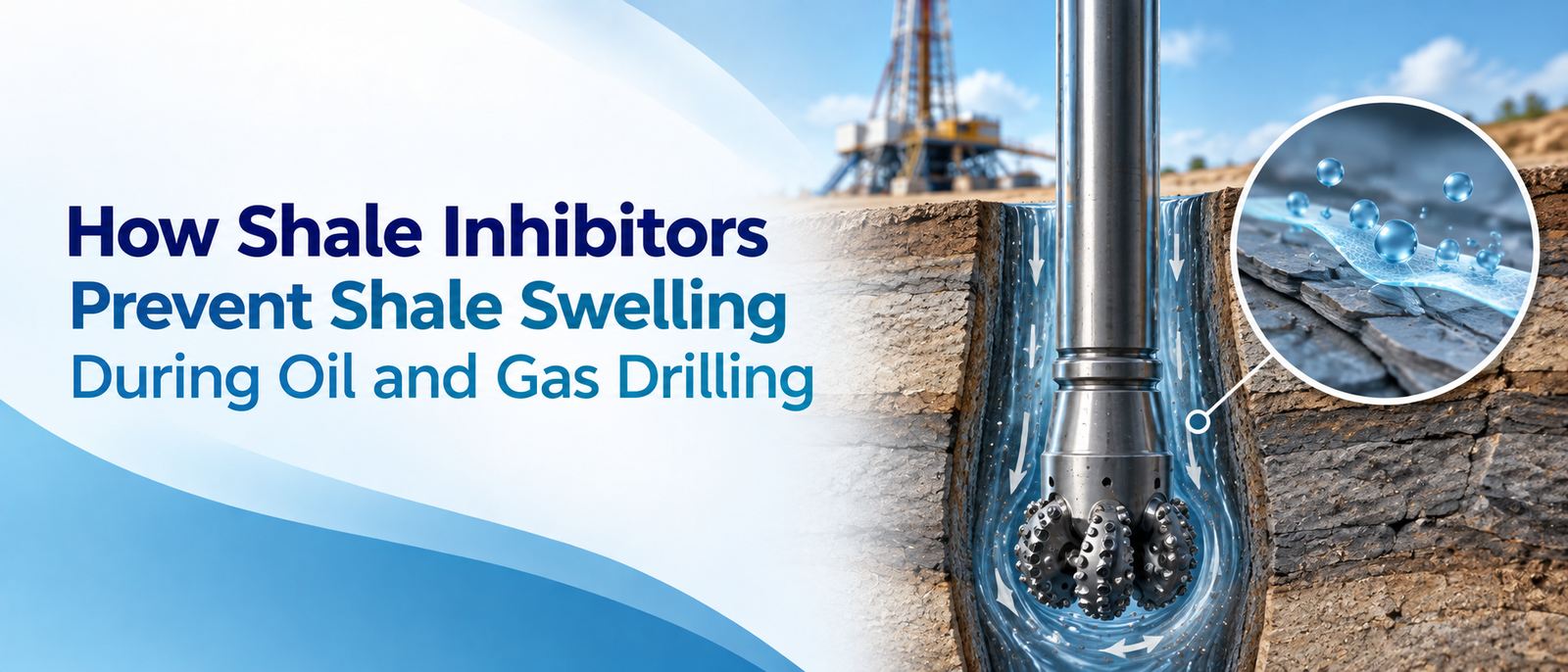
Shale formations can create significant challenges during oil and gas drilling because they may react with water, absorb fluids, and undergo swelling or dispersion. These reactions can contribute to wellbore instability, increased torque and drag, stuck pipe, poor hole cleaning, and other drilling difficulties. For this reason, shale inhibitors are an important component of modern drilling-fluid systems.
As part of the broader category of oil and gas chemicals, shale inhibitors are formulated to reduce the interaction between reactive shale formations and drilling fluids. Understanding how they work can help drilling engineers and oilfield chemical specialists develop more stable and efficient drilling operations.
What Causes Shale Swelling During Drilling?
Shale is a fine-grained sedimentary rock that can contain reactive clay minerals. When water-based drilling fluids come into contact with certain shale formations, water can enter the clay structure.
This hydration process may increase the volume of the clay and cause shale swelling. Hydrated shale can become weaker and more prone to dispersion, potentially resulting in wellbore instability.
The severity of shale reactivity depends on factors such as mineral composition, formation characteristics, drilling-fluid chemistry, salinity, temperature, and exposure time.
What Are Shale Inhibitors?
Shale inhibitors are drilling-fluid additives designed to minimize shale hydration, swelling, dispersion, and related wellbore instability.
They work through different chemical mechanisms depending on their composition. Some inhibitors reduce water interaction with reactive clay surfaces, while others can help stabilize clay particles and limit hydration.
Common approaches to shale inhibition include inorganic salts, polymers, amine-based chemistry, encapsulating polymers, and other specialized oilfield chemical technologies.
The selection of an inhibitor depends on the formation and the overall drilling-fluid system.
How Do Shale Inhibitors Prevent Shale Swelling?
- Limiting Water Interaction One of the primary objectives of shale inhibition is to reduce the amount of water that enters reactive clay structures. Certain shale inhibitors modify the interaction between the drilling fluid and shale surface, helping reduce hydration and minimize the potential for swelling.
- Stabilizing Reactive Clay Some shale formations contain clay minerals that are particularly sensitive to water. Chemical inhibitors can interact with clay surfaces and help reduce the tendency of clay particles to hydrate or disperse. This can contribute to improved wellbore stability during drilling.
- Reducing Shale Dispersion Swelling is not the only concern. Reactive shale can break down into smaller particles and disperse into the drilling fluid. This can increase the solids content of the mud and potentially affect rheology and filtration characteristics. Appropriate shale inhibitors can help maintain shale integrity and reduce dispersion.
- Supporting Wellbore Stability By controlling hydration and dispersion, shale inhibitors can contribute to a more stable wellbore. Improved stability may help reduce problems such as sloughing shale, tight hole conditions, excessive torque, drag, and difficulties during tripping operations.
Why Are Shale Inhibitors Important in Oil and Gas Drilling?
Wellbore stability is a major consideration in drilling operations, particularly when formations contain reactive shale.
An appropriately designed drilling-fluid system can help manage formation-fluid interactions and maintain desirable drilling performance. Shale inhibitors are therefore frequently evaluated alongside other oil and gas chemicals, including fluid-loss additives, viscosifiers, lubricants, emulsifiers, wetting agents, and shale stabilizers.
The goal is not simply to add an inhibitor but to develop a compatible drilling-fluid system that meets the requirements of the specific formation.
How Are Shale Inhibitors Selected?
There is no single shale inhibitor suitable for every drilling environment. Selection should consider several technical factors:
Formation mineralogy: The type and concentration of reactive clay minerals influence shale reactivity.
Drilling-fluid type: The requirements for water-based mud can differ significantly from those for oil-based or synthetic-based systems.
Temperature and pressure: High-temperature and high-pressure conditions can influence additive performance.
Salinity and fluid chemistry: Ionic composition and other additives can affect shale-fluid interactions.
Environmental requirements: Depending on the drilling location and regulatory framework, environmental and handling characteristics may also influence chemical selection.
Laboratory testing: Swelling, dispersion, rheology, filtration, and compatibility tests can help determine whether a selected inhibitor is appropriate.
Frequently Asked Questions About Shale Inhibitors: What are shale inhibitors used for?
Shale inhibitors are used in drilling-fluid systems to reduce shale hydration, swelling, dispersion, and associated wellbore instability.
How do shale inhibitors reduce shale swelling?
They can reduce water interaction with reactive clay minerals, stabilize clay surfaces, and limit hydration and dispersion. The exact mechanism depends on the inhibitor chemistry.
Why is shale swelling a problem in oil and gas drilling?
Shale swelling can contribute to wellbore instability, tight hole conditions, increased torque and drag, stuck pipe, and challenges with hole cleaning and tripping.
Are shale inhibitors oil and gas chemicals?
Yes. Shale inhibitors are a category of specialized oil and gas chemicals used as drilling fluid additives for managing reactive shale formations.
Conclusion
Shale swelling and dispersion can create operational challenges during oil and gas drilling, particularly in formations containing reactive clay minerals. Shale inhibitors help address these challenges by controlling hydration, stabilizing clay, reducing dispersion, and supporting wellbore stability.
Choosing the right inhibitor requires an understanding of formation mineralogy, drilling fluid chemistry, operating conditions, environmental requirements, and compatibility with other oil and gas chemicals. Application-specific laboratory testing can help drilling teams identify an effective chemical system and optimize drilling-fluid performance for the target formation.